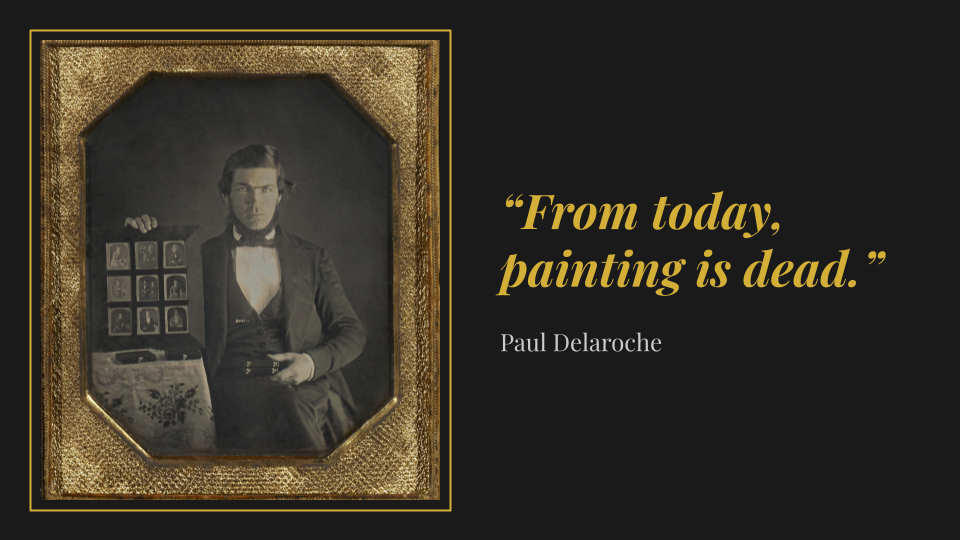
“From today, painting is dead.” The sentence is attributed to the French painter Paul Delaroche after he first saw a daguerreotype. The quote reminds us of a real fear of the time: photography had arrived, and painting seemed to have lost its old duty of capturing the world as it appears. But painting did not die. On the contrary, it became freer. Once the camera could reproduce the look of things, painters could ask better questions: how seeing feels; how memory rearranges what it keeps; how emotion bends reality; how time, movement, dreams, or invisible structures might be given a body. Out of this release came much of modern art: Impressionism, Symbolism, Expressionism, Cubism, Abstraction, Surrealism.
Something similar may now be happening to mathematics and science. Large Language Models (LLMs) can already solve “gentle problems.” The Fields Medalist Timothy Gowers recently used ChatGPT 5.5 Pro to solve a combinatorics problem, and he got a correct solution! He concludes:
Tim Gowers: AI Is Already Producing PhD-Level Mathematics.
The lower bound for contributing to mathematics will now be to prove something that LLMs can’t prove, rather than simply to prove something that nobody has proved up to now and that at least somebody finds interesting.
Although this doesn’t announce the end of mathematics or science, it definitely changes the ground under the feet of those still learning how to enter this endeavor. And the ground is moving quickly. AI models are becoming astonishingly good at an unprecedented pace, and as long as “some” original research exists, there will be new data that prevents the whole system from “cannibalizing” itself. This means we may still need humans to do original work, but perhaps fewer of them, and this is exactly where the unease begins!
Many researchers are already working with a small team of AI assistants: testing ideas faster, searching more widely, and doing work that would have been impossible alone. So, for a researcher who can secure a position at a prestigious institution with access to the latest models, the future may look bright. But for others, it can be a fragile brightness. Even the privileged researcher must make sure not to become the least necessary member of that team! Academia, after all, is not only a place for creativity and originality. It also has a corporate face: metrics, rankings, temporary contracts, visas, deliverables, and replaceable people.
State-of-the-art AI is not free, not cheap, and not available to everyone in the same way. As these tools are becoming part of the research ecosystem, access to them will become another hidden inequality in academia. On top of this, major AI companies are not like public libraries; they have owners, markets, incentives, and conversations with Big Brother. So the question is no longer only whether LLMs can do research. They already can do some of it. The question is what kind of academic world we build around them: who becomes freer, who becomes replaceable, and who is left outside the door.